My name is Ellie, and I’m a young trainer with AYPH. I was recently one of the young people involved with the Foundations Outcomes Framework and Measures Database work with Foundations, AYPH, Oxford MeasurEd and The Brilliant Club. In this blog I set out the work we did and the importance of engaging young people in the development of frameworks that relate to their lived experience.
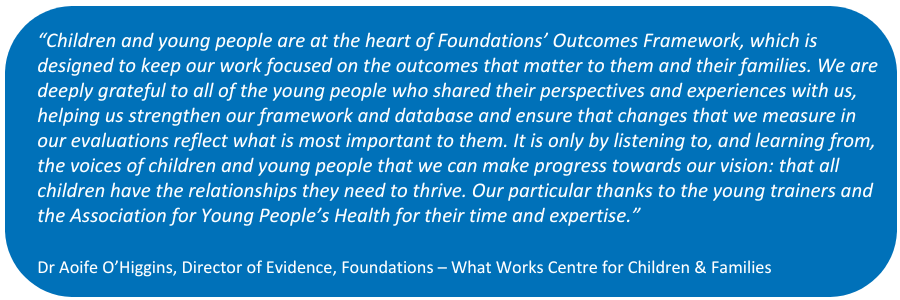
Foundations is the national What Works Centre for Children and Families, who work to ensure that vulnerable children have the foundational relationships they need to thrive. This project was important to ensure that Foundations’ evaluations focus on the most important outcomes for vulnerable children and young people. Foundations’ Outcomes Framework includes ten measurable outcomes for babies, children, young people and their parents/caregivers. This project included the voices of children, young people and families to make sure the framework focused on the things that are most important in helping children, young people and families. In addition to this, the Measures Database is a list of tools that can be used to measure outcomes in the framework which provides practical and statistical information.
As a young person involved in this work, we had a series of meetings with the project team in which we were involved in giving our input into the ten measurable outcomes. We shared experiences and our thoughts on a number of the issues raised. I feel it is really important that the voice of those with lived experience is included as we can offer a unique insight into what is important, and how to ensure engaging with children, young people and families is done in an accessible way.
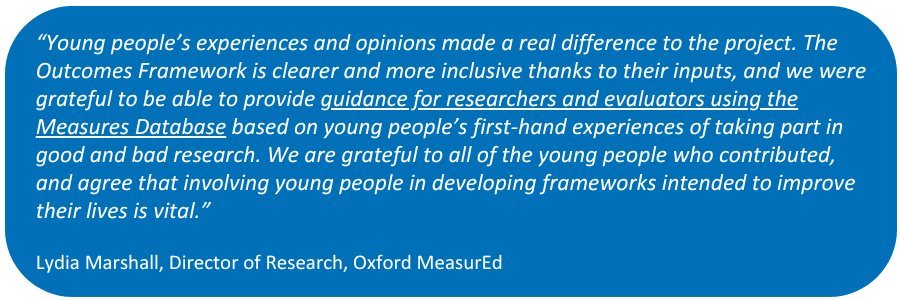
Being involved in this process has allowed me to see the evolution of these frameworks, something I feel is so important in allowing young people feel like they have made a difference. Not just knowing that but seeing it too and having an outcome that feels rightly co-produced.
In response to our meetings, there were a number of changes made to the outcome framework, some of these include:
- The language was changed so that the outcomes are about the positive changes Foundations is trying to make, instead of focusing on negative behaviour.
- More clarity and clearer language was used so that it is more easily accessible and understandable to all.
- Language around family, the term ‘caregiver’ is now used to be inclusive of all types of family.
- Including the young person’s voice so that young people’s voices are at the core of the framework.
In addition all the outcomes that were voted as most important by young people were included in the framework.
In relation to the measures database we were able to feed in our views on what makes research with young people with lived experience of the care system or other vulnerabilities work in the best way possible. One of my fellow young trainers Opeyemi was involved in this and she stressed the importance of a trauma informed approach where researchers are as informed about the subject matter as possible and can demonstrate real compassion and avoid pity. As she said:
![Quote from an AYPH Young Trainer in blue text, in a green circle on a white background "you don’t need to be an expert in [young people’s experience] but having the basics of the subject in your mind before you start work in this area is key."](https://ayph.org.uk/wp-content/uploads/2026/09/YT-quote-foundations.png "YT quote foundations")
I feel this project is a really strong example of young people’s voices being heard and making a real impact on the frameworks that are created and are there to support them. It can often feel that young people’s voices or opinions are pushed aside, whereas being a part of this process has shown that when young people are included in all aspects of framework development, it can benefit all involved and produce something meaningful and supportive to those who will need it most. I really enjoyed being a part of this work, and hope to see more things like it being developed with young people and their families at the centre of it.
Author: Ellie, AYPH Young Trainer
September 2026